


The Most Famous Cycling Races: Grand Tours, Monuments and World Championships
Which races matter most in professional road cycling? Start with three families: the three-week Grand Tours, the five one-day Monuments, and the UCI Road World Championships.
They reward very different skills. A rider who can survive three weeks of climbing and time trials is solving a different problem from a Classics specialist fighting for position on cobbles or a national-team leader chasing a rainbow jersey in a single race.
What are the most famous cycling races?
For professional road cycling, the clearest starting point is the Tour de France, Giro d’Italia and Vuelta a España; the five Monuments — Milano–Sanremo, Tour of Flanders, Paris–Roubaix, Liège–Bastogne–Liège and Il Lombardia; and the UCI Road World Championships.
That list is more useful than a simple “top 10” ranking because prestige in cycling is not one-dimensional. Grand Tours reward sustained performance over weeks, the Monuments compress risk and tactics into one day, and the World Championships replace trade teams with national selections and award the rainbow jersey.
| Race or family | Format | Identity | What usually decides it |
|---|---|---|---|
| Tour de France | Grand Tour | Yellow jersey; the best-known road race globally | Climbing, time trials, recovery, team support and consistency |
| Giro d’Italia | Grand Tour | Maglia Rosa; Italian mountains and varied conditions | Mountain endurance, adaptation and three-week consistency |
| Vuelta a España | Grand Tour | Red jersey; often steep and explosive climbing | Repeated climbing efforts, recovery and aggressive racing |
| UCI Road World Championships | Championship event | National teams and rainbow jerseys | Course profile, national-team tactics and one-day execution |
| The five Monuments | One-day Classics | Five historic races with very different terrain | Positioning, endurance, timing, terrain-specific skill and tactics |
Scope note: this guide focuses on the major annual professional road races and uses the historic men’s editions when giving first-edition dates. Many of these events also have elite women’s races with their own histories, routes and formats.

Grand Tour, Monument or World Championship: what changes?
Road cycling uses several race formats, and the format changes what “being the strongest” actually means. The same rider can be a major favourite in one event and have a much smaller advantage in another because fatigue, terrain, team structure and tactical risk are different.
Grand Tours: win the accumulated race
A Grand Tour is a stage race lasting roughly three weeks. General classification is based on cumulative time, so riders must perform repeatedly, recover overnight and limit bad days as well as create good ones.
Monuments: one chance
A Monument is decided in a single day. There is no tomorrow to recover lost time. Positioning, punctures, weather, attacks and a few seconds of hesitation can transform the result.
Worlds: race for a nation
At the UCI Road World Championships, riders represent national teams rather than their usual trade teams. The course changes with the host, so the type of rider favoured can change substantially from year to year.
The practical distinction: Grand Tours reward repeatability and recovery; Monuments reward race-day execution on specialised terrain; the Worlds reward one-day performance on a changing course under national-team tactics.
Want the calendar structure as well? Read DEMON’s UCI WorldTour guide to races, teams, points and the calendar.
The three Grand Tours
The Tour de France, Giro d’Italia and Vuelta a España are cycling’s three Grand Tours. Each combines many race types inside one event: flat stages, hilly days, mountain stages, time trials and transitional stages. The general classification winner is the rider with the lowest cumulative time after all stages.
That makes a Grand Tour more than a sequence of individual victories. A contender must climb with the best, avoid costly losses, manage fatigue, use team-mates intelligently and recover for the next stage. Sprinters, climbers and breakaway specialists can pursue their own goals at the same time, creating several competitions within the same race.
Tour de France
First held in 1903. The leader wears yellow. It is the reference point for global awareness of professional road cycling.
Giro d’Italia
First held in 1909. The leader wears pink. Mountain terrain and variable weather often shape the race.
Vuelta a España
First held in 1935. The leader wears red. Steep summit finishes and late-season dynamics often encourage aggressive racing.
Tour de France: cycling’s best-known stage race
The Tour de France is the road race most likely to be recognised even by people who do not follow cycling year-round. Its combination of three-week endurance, global coverage, mountain stages and the Maillot Jaune has made it the sport’s central annual showcase.

The race changes course annually, but its sporting logic remains recognisable. General-classification contenders must manage major mountain days, time-trial kilometres when included, crosswinds, crashes, positioning and cumulative fatigue. The Alps and Pyrenees are recurring reference points, but other mountain ranges and regions can be equally decisive.
The Yellow Jersey identifies the overall race leader. Other classifications create parallel objectives for points, climbing and young-rider performance, while individual stage wins can define a rider’s Tour even without a general-classification challenge.
For a new fan, the easiest way to understand the Tour is to watch how teams protect their leaders before decisive terrain. A mountain attack is only the visible end of a process that may have involved hours of pace control, breakaway management, feeding and positioning.
What makes the Tour different: three-week performance is combined with unusually high sporting and media pressure. A contender cannot rely on one exceptional day; avoiding major losses is as important as creating gains.
For a deeper historical view, see DEMON’s Tour de France history, characters and facts.
Giro d’Italia: the race for the Maglia Rosa
The Giro d’Italia is Italy’s Grand Tour. Its general-classification leader wears the Maglia Rosa, introduced in 1931, and the race frequently draws its identity from the Alps, Dolomites, Apennines and the variety of roads that connect them.

Mountain stages are only part of the challenge. A Giro contender may need to cope with cold at altitude, rain on technical descents, exposed roads, time trials and hard stages where the terrain never becomes truly flat. Route design varies from year to year, so there is no single “Giro formula”.
The pink leader’s jersey is one of cycling’s most recognisable symbols. But, as at every Grand Tour, the winner is determined by accumulated time rather than by the number of stages won. That distinction explains why a rider can win several stages and still finish far behind the overall winner.
The Giro is particularly useful for understanding how terrain and weather interact with race strategy: a mountain stage can be controlled for hours, then split apart quickly when fatigue and gradients combine near the finish.
What makes the Giro different: its route often combines high mountains, technical roads and variable spring conditions, rewarding riders who can adapt as well as climb.
For the historical roll of honour, see DEMON’s complete Giro d’Italia winners guide.
Vuelta a España: steep climbs and late-season racing
The Vuelta a España, usually shortened to La Vuelta, is Spain’s Grand Tour. Its first edition was held in 1935, while today’s general-classification leader is identified by the red jersey.

La Vuelta has developed a reputation for steep summit finishes and stages that encourage repeated accelerations rather than only long, steady climbing. The exact balance changes every edition, but short severe gradients can make time gaps appear rapidly.
Its place later in the road season also creates a different competitive context. Some riders arrive after targeting earlier Grand Tours; others build their season around the Vuelta; and emerging riders may use it to establish themselves at three-week level.
Spain’s varied geography gives organisers many different race types, from exposed plateaus and coastal roads to the Pyrenees, Cantabrian mountains and high-altitude finishes.
What makes the Vuelta different: the combination of steep climbing and late-season form can produce open, aggressive racing and rapid changes in the general classification.
For the historical winners, see DEMON’s Vuelta a España winners list.
UCI Road World Championships: one course, national teams, one year in rainbow stripes
The UCI Road World Championships differ fundamentally from most of the season because riders represent their countries rather than their regular trade teams. The host and route change, so the championship can favour very different rider profiles from one edition to the next.

The modern World Championships include road races and individual time trials across several categories, plus the team time trial mixed relay. The elite road race is the event most fans associate with the rainbow jersey, but each world title belongs to its specific discipline and category.
Road race
A mass-start race where team numbers, course selection, positioning, endurance and attack timing all matter. The road race champion wears the rainbow jersey in that speciality for the following year.
Individual time trial
Riders start separately and race against the clock. Pacing, aerodynamics, power delivery, cornering and course management become central.
Team time trial mixed relay
A national-team relay format rather than the old trade-team time trial. It combines men’s and women’s team-time-trial efforts into one national result.
The rainbow jersey has an unusual status because it remains visible throughout the following season: the reigning champion may wear it when competing in the discipline, category and speciality in which the title was won. Former champions can continue to display rainbow bands as recognition of past world titles.
Why the Worlds feel different: there is no three-week safety net and no permanent course identity. National-team composition and route design can change the tactical problem completely from one year to the next.
The Cycling Monuments
The five traditional Cycling Monuments are Milano–Sanremo, the Tour of Flanders, Paris–Roubaix, Liège–Bastogne–Liège and Il Lombardia. They share historic importance and one-day prestige, but they should not be treated as five versions of the same race.
Milano–Sanremo is defined by extreme distance and a tense late finale; Flanders by repeated cobbled climbs and positioning; Roubaix by severe pavé; Liège by Ardennes climbing; and Lombardia by long Italian climbs and descending. A rider’s strengths can therefore translate very differently from one Monument to another.
For a dedicated comparison of all five, see DEMON’s Cycling Monuments guide: routes, history and why they matter.
Milano–Sanremo: distance first, then a high-speed finale
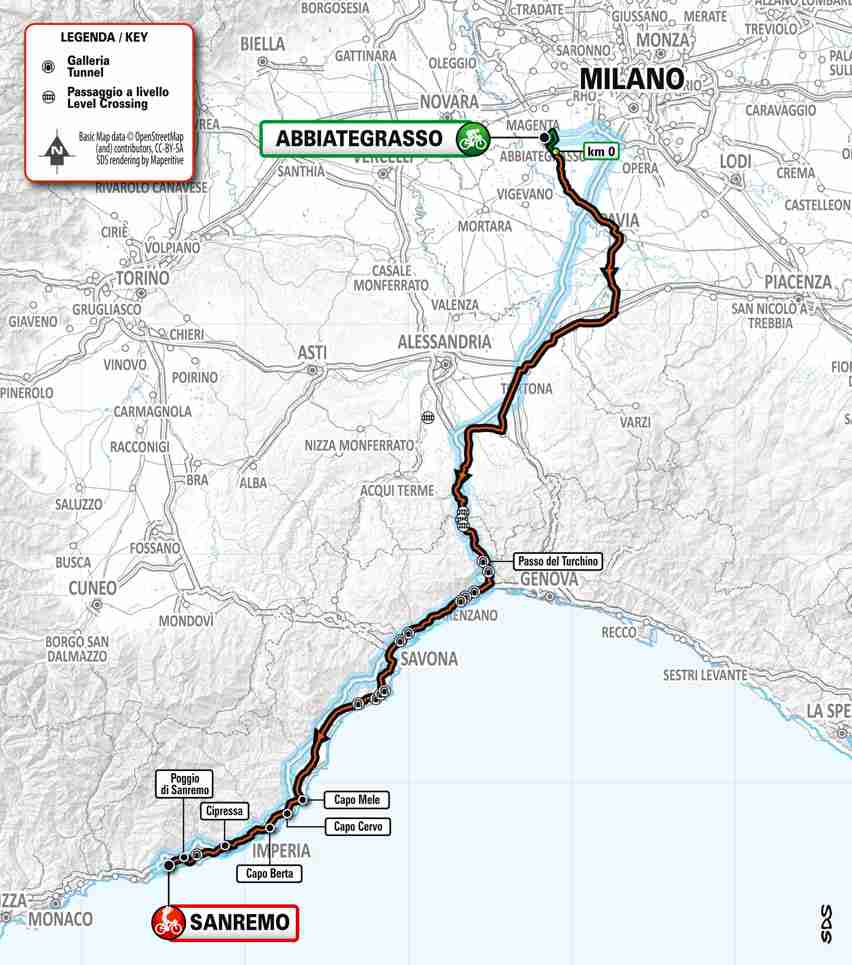
Milano–Sanremo is the longest of the five Monuments and one of the hardest races to reduce to a simple rider type. Much of the day can look controlled, yet almost 300 kilometres of accumulated fatigue change the meaning of every acceleration in the finale.
The Cipressa and especially the Poggio di Sanremo are central to the modern finale. The Poggio is not a huge mountain climb; its importance comes from where it appears after such a long race. An attack over the top, the technical descent or a reduced sprint can all produce the winner.
That tension is the defining feature of Sanremo. Sprinters want enough control to preserve a finishing chance, while attackers know the final climbs and descents may be their last opportunity to avoid a sprint.
Watch for: positioning before the Cipressa, the pace on the Poggio, gaps created over the crest and whether attackers can keep them through the descent and run-in.

Tour of Flanders: cobbled climbs and a battle for position

The Tour of Flanders — Ronde van Vlaanderen — compresses several problems into the same race: narrow roads, cobbles, steep bergs and repeated fights for position before each decisive sector.
Climbs such as the Oude Kwaremont, Paterberg and Koppenberg are short compared with Grand Tour mountains, but they arrive at high intensity and are often approached through roads where moving up is difficult. Entering a key climb too far back can cost energy or force a rider to react after a split has already formed.
Flanders therefore rewards more than raw power. Riders need repeated acceleration, technical confidence, awareness of wind and road position, and the ability to make decisions while fatigued.
Watch for: the fight before each berg. The decisive move may begin before the climb itself, when teams accelerate to place their leaders near the front.
Paris–Roubaix: why the pavé changes everything

Paris–Roubaix is defined by historic cobbled sectors that increase vibration, puncture risk, bike-handling demands and the cost of poor positioning. It is not simply a road race with rough surfaces added: the pavé changes how riders choose lines, conserve momentum and use their teams.
The Trouée d’Arenberg, Mons-en-Pévèle and Carrefour de l’Arbre are among its best-known sectors. The exact race situation changes every year, but the principle is consistent: entering critical cobbles in a poor position can create a problem before strength becomes relevant.
Roubaix also contains an unusual amount of uncertainty. Mechanical trouble, crashes or a split on one sector can reshape the race in seconds, which is why tactical judgement and resilience matter alongside power.
Watch for: who reaches the most difficult sectors near the front, which riders can maintain speed across rough stones, and who still has team support after the race fragments.
Liège–Bastogne–Liège: repeated Ardennes climbing

Liège–Bastogne–Liège is known as La Doyenne — “the Old Lady” — and traces its history to 1892. Its difficulty comes less from one single mountain than from accumulated climbing through the Ardennes after a long day of racing.
Climbs such as the Côte de la Redoute and Côte de la Roche-aux-Faucons can be used to reduce the group or launch race-winning attacks. Because many strong climbers and punchy all-rounders may still be present late in the race, timing becomes critical.
Attack too early and cooperation behind may bring the move back. Wait too long and a stronger finisher may retain a sprint option. That tension makes Liège a useful example of how one-day climbing tactics differ from a mountain stage in a Grand Tour.
Watch for: the size and composition of the group after the late climbs. Who still has a team-mate can matter almost as much as who appears strongest.
Il Lombardia: climbing and descending at the end of the season

Il Lombardia, historically known as the Giro di Lombardia, is the final Monument of the traditional road season and has been raced since 1905. Its identity is built around the roads and climbs of Lombardy, often between the areas of Como and Bergamo.
The Madonna del Ghisallo is one of the race’s enduring symbols, while the exact climbing sequence varies with the route. Long climbs and technical descents make Lombardia a different problem from the spring cobbled Monuments and generally more favourable to riders with strong climbing ability.
Because it arrives late in the year, form and accumulated season fatigue also become part of the story. The race can reward riders who still combine endurance with the confidence to attack or descend decisively.
Watch for: attacks on the final major climbs and whether gaps grow or shrink on the descents and flatter connections that follow.
Where the famous races sit in a typical road season
If you are new to professional cycling, following the season in sequence makes the differences between the races easier to understand. Exact dates and routes change, but the annual rhythm is broadly recognisable.
Useful distinction: “WorldTour race” and “famous race” are not synonyms. WorldTour is part of the UCI competition structure; fame and historical prestige are broader concepts. That is why this guide groups races by format rather than presenting an artificial numerical ranking.
What kind of rider does each race tend to reward?
No race has a permanent “correct” rider profile: routes change and champions can win in unexpected ways. Still, each event creates a recurring set of demands that helps explain why certain riders target it.
| Race | Recurring demands | Typical tactical question | Signature feature |
|---|---|---|---|
| Tour de France | Climbing, time-trial ability, recovery, consistency | Where can a GC contender gain time without exposing weaknesses elsewhere? | Three weeks under maximum attention |
| Giro d’Italia | Climbing, adaptability, recovery, handling variable conditions | How should a contender manage mountains, weather and route variability? | Maglia Rosa and Italian mountain racing |
| Vuelta a España | Steep climbing, repeated accelerations, recovery | Can rivals create gaps on short severe climbs? | Explosive late-season stage racing |
| UCI Road Worlds | Course-specific ability, one-day endurance, national-team tactics | Which nation controls the race, and which rider profile does the course favour? | Rainbow jersey |
| Milano–Sanremo | Extreme endurance, positioning, descending, sprint or late attack | Can attackers escape before the fastest finishers regroup? | Nearly 300 km before a compressed finale |
| Tour of Flanders | Cobbles, short climbs, repeated accelerations, positioning | Who reaches the key bergs in the front group with energy left? | Cobbled Flemish climbs |
| Paris–Roubaix | Power, bike handling, resilience, positioning | Who survives the decisive pavé sectors without losing contact? | Historic rough cobbles |
| Liège–Bastogne–Liège | Endurance, climbing, punch, tactical timing | When should a climber or puncheur commit to the winning move? | Repeated Ardennes climbs |
| Il Lombardia | Climbing, descending, endurance, late-season condition | Can an attacker create a gap on the final climbs and protect it to the finish? | Autumn climbing in Lombardy |
Other major races worth knowing
The Grand Tours, Worlds and Monuments provide the clearest core, but they are not the whole professional calendar. One-week stage races and other major one-day Classics can be objectives in their own right and important preparation for bigger targets.
- Paris–Nice
- Tirreno–Adriatico
- Critérium du Dauphiné
- Tour de Suisse
- Strade Bianche
- Amstel Gold Race
- La Flèche Wallonne
- Clásica San Sebastián

FAQ about the world’s most famous cycling races
What is the most famous cycling race in the world?
The Tour de France is generally the best-known professional road cycling race worldwide. Its Yellow Jersey, long history and three-week format give it visibility well beyond specialist cycling audiences.
What are the three Grand Tours in cycling?
The three Grand Tours are the Tour de France, Giro d’Italia and Vuelta a España. They are multi-stage races lasting roughly three weeks, with overall victory decided by cumulative time.
What are the five cycling Monuments?
The five traditional Monuments are Milano–Sanremo, Tour of Flanders, Paris–Roubaix, Liège–Bastogne–Liège and Il Lombardia. They are historic one-day Classics with distinct terrain and tactical demands.
Is Strade Bianche a cycling Monument?
No. Strade Bianche is a major one-day race, but the traditional Monument group still consists of the five historic races listed above.
What is the difference between a Classic and a Monument?
“Classic” is a broad term for established one-day road races. “Monument” refers to the traditional group of five especially historic one-day Classics: Milano–Sanremo, Flanders, Roubaix, Liège and Lombardia.
Why is Paris–Roubaix so difficult?
The race combines long distance with severe cobbled sectors, constant positioning battles, vibration, puncture and mechanical risk, and difficult bike handling. The decisive sectors can fragment the race very quickly.
Why is the rainbow jersey important?
A reigning UCI World Champion may wear the rainbow jersey when competing in the discipline, category and speciality in which the title was won. It makes the current world champion visible throughout the following year.
Where do the Olympic road races fit?
The Olympic road race and time trial are major international titles, but they are not annual events and do not belong to the Grand Tour or Monument categories. This guide focuses on the recurring annual race families that structure the professional road season.
Learn the formats and the famous races make more sense
The Tour de France, Giro d’Italia and Vuelta a España are famous because they turn stage racing into a three-week test of performance and recovery. The five Monuments are famous because each distils a distinct one-day challenge into a race with deep history. The Road World Championships add a different dimension again: national teams, a changing course and the rainbow jersey.
Once those differences are clear, professional cycling becomes easier to follow. Instead of asking which race is simply “hardest”, you can ask a better question: what problem is this race asking a rider to solve? That question explains why cobbles, mountain passes, a time trial, a 300-kilometre day or one perfectly timed attack can each define a career.
↑ Back to the beginningReceive Your 15% Reward Coupon
Explore DEMON cycling glasses for road cycling, mountain biking, gravel and long-distance riding.
Use the code below to receive 15% off your purchase:
Choose your eyewear according to fit, route, light conditions and the type of riding you actually do.
