


How to Clean Ski Goggles Safely
The safest way to clean ski goggles is to treat the outer lens, inner anti-fog surface, foam, frame, and strap differently. Use clean microfiber, remove snow before wiping, keep liquids controlled, and never rub the inside of the lens while it is wet.
That simple distinction prevents the most common cleaning mistakes: scratches, damaged coatings, saturated foam, blocked vents, and moisture trapped around a double-lens system.

What is the safest way to clean ski goggles?
First remove loose snow, ice, dust, or grit without rubbing. Then clean only the area that actually needs attention with a clean microfiber cloth. The outer lens can be gently wiped once loose particles and excess moisture are gone. The inner lens requires much more care because it commonly carries an anti-fog treatment: if it is wet, blot it lightly or let it air-dry instead of rubbing.
| Part of the goggles | Safest routine | What to avoid |
|---|---|---|
| Outer lens | Remove loose particles first, then use clean microfiber with very light pressure. Use only a compatible lens cleaner if needed. | Paper, gloves, clothing, dry rubbing over grit, household glass cleaner, solvents. |
| Inner lens | Touch as little as possible. If wet, gently blot with clean microfiber and let it air-dry fully. | Rubbing while wet, aggressive polishing, alcohol, household cleaners, unapproved anti-fog products. |
| Frame | Wipe with a soft microfiber cloth, slightly dampened with lukewarm water when necessary. | Solvents, abrasive sponges, high heat, soaking. |
| Face foam | Blot surface dirt and sweat with a barely damp cloth, then air-dry completely. | Saturating the foam, hard scrubbing, twisting, storing while damp. |
| Elastic strap | Wipe lightly with a damp microfiber cloth and leave extended to dry naturally. | Strong detergent, direct heat, tumble drying, storing wet. |
Lens coatings and construction vary between models. Some manufacturers allow carefully rinsing a removable lens with lukewarm water; others recommend minimal liquid. If your goggle has model-specific care instructions, follow those instructions before any general cleaning advice.
How to clean the ski goggle frame

Clean the frame separately from the lens
The frame collects sweat, sunscreen, dust, salt residue, and snow. It is usually less delicate than the lens, but aggressive cleaners can still affect finishes, plastics, adhesives, and nearby foam.
Start with a dry microfiber cloth. If residue remains, slightly dampen a clean section of the cloth with lukewarm water and wipe the frame gently. Work around hinges, lens edges, and vent areas without forcing moisture into the lens assembly.
Avoid alcohol, acetone, household glass cleaner, disinfectant spray, and other solvents unless the goggle manufacturer explicitly approves them for that exact material.
How to clean the foam on ski goggles

Blot the surface instead of soaking it
Face foam absorbs sweat and moisture by design, so it needs time to dry after every ski day. For light dirt, press a barely damp microfiber cloth against the surface and lift residue away rather than scrubbing aggressively.
Do not hold the whole goggle under running water simply to wash the foam. Excess water can take a long time to evaporate and may reach adhesive seams or areas around the double lens.
If the foam is heavily soiled, check the manufacturer's care instructions before using soap or removing the lens. Construction differs between goggles, and not every foam or adhesive system should be washed in the same way.
How to clean the elastic strap

Remove sweat and salt without stretching the band
Wipe the strap with a slightly damp microfiber cloth, paying attention to the areas that contact your helmet or hair. Keep strong detergent away from the lens and foam, and avoid repeatedly pulling the strap while it is wet.
Let the strap dry naturally at room temperature. Do not place the goggles on a radiator, heater, dashboard, or other concentrated heat source: high heat can affect elastic, foam, adhesives, and frame materials.
Outer lens and inner lens need different cleaning
The most important ski goggle cleaning rule is simple: the outer lens can usually tolerate gentle cleaning; the inner surface should be touched as little as possible. The inner lens is commonly treated to manage fogging, and that treatment is especially vulnerable when wet.

Think “wipe outside, blot inside”
On the outer lens, first remove loose snow, ice, or grit, then gently wipe fingerprints and smudges with clean microfiber. On the inner lens, if moisture is present, shake out loose snow and dab or blot the remaining moisture. Do not scrub back and forth.
Once the inside is completely dry, a very light touch with clean microfiber may remove a remaining mark if the manufacturer allows it. If the mark does not affect vision, leaving the inner surface alone is often safer than repeated polishing.
Moisture can soften or make the anti-fog surface more vulnerable. Rubbing a wet inner lens can leave scratches, streaks, or reduce the effectiveness of the coating.
Many snow goggles use two lenses separated by an insulating air gap. That structure helps reduce condensation, but it also means liquid should not be forced into edges, vents, or sealing areas. If you want a deeper explanation, read DEMON's guide to double-lens ski goggle technology.
How to clean ski goggle lenses step by step
Use this method for normal post-ski cleaning and for goggles that have fingerprints, dried snow marks, or light grime. If the lens has a special mirror, anti-fog, hydrophobic, or oleophobic coating, keep the process as gentle as possible.
Remove loose snow and ice first
Shake the goggles gently. If ice is stuck to the lens, let it soften naturally at room temperature instead of scraping it away.
Check for grit before touching the lens
Dust, sand, dried salt, or small particles can create scratches when dragged across the surface. Do not rub a dirty lens dry.
Blot excess water
If the lens is wet, use a clean microfiber cloth or goggle bag to blot droplets. Avoid pressure and repeated rubbing.
Clean the outer lens only as much as necessary
Once loose particles are gone and the lens is no longer dripping wet, use a clean, dry section of microfiber to remove fingerprints and smudges with light strokes.
Leave the inner anti-fog surface alone when possible
If the inside is wet, dab rather than wipe. Let the goggle air-dry completely before attempting to remove any remaining mark.
Dry the whole goggle before storage
Leave the goggles in a dry, ventilated place at room temperature until the lens, foam, frame, and strap are fully dry.
As a general rule, do not rinse the entire assembled goggle under a tap. Running water can saturate face foam and may reach vents, lens edges, or a double-lens seal. If your manufacturer specifically allows a removable lens to be rinsed with lukewarm water, follow that model-specific method instead.
How to clean ski goggles with ventilation holes

Keep liquid away from openings and lens edges
Ventilation openings help move humid air away from the inside of the goggle. If those openings become blocked by snow, ice, dust, or dried residue, airflow can be reduced.
Clear loose snow by shaking the goggles and allow ice to melt naturally. Do not push cotton swabs, sharp objects, brushes, or compressed air deep into vent foam. If you use a compatible lens cleaner, apply a minimal amount to the microfiber cloth rather than spraying directly toward ventilation holes.
For more detail on why airflow matters, see DEMON's guide to the ventilation system for snow goggles.
Should you use anti-fog spray or lens cleaner?
A cleaning product can be useful, but only when it is compatible with the lens and coating. Factory anti-fog treatments do not always need an additional product, and an unapproved cleaner can do more harm than good.

Use only a product designed for compatible lenses
Do not improvise with window cleaner, hand sanitiser, alcohol, acetone, or household detergent on the lens. These products may affect mirror finishes, hydrophobic layers, or anti-fog treatments.
If you use a dedicated anti-fog or lens-cleaning product, follow its instructions and the lens manufacturer's guidance. With vented goggles, place the product on the cloth rather than spraying toward openings.
If the inner lens already has a factory anti-fog treatment, avoid adding another treatment unless compatibility is specifically indicated.
What not to use on ski goggle lenses
Most lens damage during cleaning comes from either abrasive contact or the wrong chemical. The safest approach is intentionally simple.
Use
- A clean microfiber goggle bag or optical-quality microfiber cloth.
- Very light pressure.
- Lukewarm water only when the model's care instructions allow it.
- A lens cleaner specifically confirmed as compatible with the coating.
- Natural air-drying at room temperature.
Avoid
- Paper towels, tissues, toilet paper, napkins, or wet wipes.
- Ski gloves, jacket sleeves, T-shirts, or towels.
- Household glass cleaner, alcohol, acetone, or solvents.
- Scraping ice or rubbing grit across the lens.
- Direct heat from radiators, hair dryers, or car dashboards.
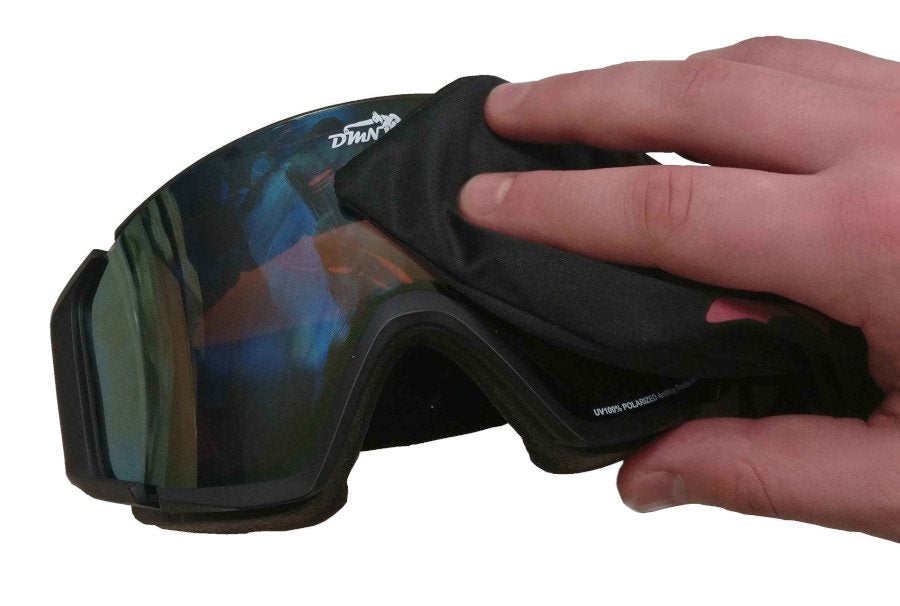
Why paper and clothing are risky
The problem is not only the material itself. A tissue, sleeve, or glove can carry dried dirt or hard particles that become abrasive when dragged over a coated polycarbonate lens. Clean microfiber is designed to pick up light oils and smudges with much less risk.
If you can see grit on the lens, do not polish through it. Remove the particles first, then clean the remaining marks.
What to do if snow, ice, or fog gets inside your goggles
A fall in powder or heavy snowfall can fill the inside of a goggle in seconds. This is exactly when people are most tempted to wipe the inner lens aggressively—and when the anti-fog surface is most vulnerable.
Snow inside
Shake out loose snow first. Do not smear melting snow across the inner lens. Blot remaining droplets only if necessary.
Ice on the lens
Let ice soften or melt naturally. Never scrape it with a lift pass, fingernail, glove buckle, or other hard object.
Fogging
Do not polish away condensation. Move to a dry, ventilated area, clear blocked vents, manage excess heat, and let airflow dry the inside.
Warm, humid air from your head can feed moisture into the goggle and reduce ventilation. If you need to remove goggles temporarily, keep them protected and allow the interior to dry rather than trapping them against wet clothing.
How to dry and store ski goggles properly
Drying is not an afterthought. A clean goggle stored while still damp can develop persistent odour, saturated foam, and recurring fogging at the start of the next ski day.
Open the goggle to room air
Take it out of your backpack or closed case as soon as practical after skiing. Leave it in a dry, well-ventilated indoor space.
Let the foam and strap dry naturally
Do not force the process with a radiator, hair dryer, tumble dryer, or other high-temperature source.
Check the vents before storage
Make sure there is no packed snow, ice, or visible debris around ventilation openings.
Store only when fully dry
Once dry, place the goggles in a clean microfiber pouch or protective case with the lens protected from keys, tools, buckles, and other hard objects.
Choose a stable storage environment
Keep goggles away from prolonged direct sunlight, high heat, and damp areas. A dry cupboard or gear shelf is preferable to a hot car or sealed wet ski bag.
When cleaning is no longer enough
Some visibility problems are signs of wear or damage rather than dirt. Cleaning harder will not solve them and may make the lens worse.
Deep scratches
Scratches in your main field of view can scatter light and remain visible after cleaning. Check whether a replacement lens is available for your model.
Delamination or trapped moisture
If haze or moisture appears between a sealed double lens, do not prise the lenses apart. Contact the manufacturer or retailer for assessment.
Damaged face foam
Foam that is separating, permanently compressed, cracking, or crumbling can affect comfort and seal. Replacement may be more appropriate than deeper cleaning.
Understand the technology you are protecting
Cleaning is easier when you know why the lens, ventilation system, and fit are built the way they are. These DEMON resources cover the complementary topics without duplicating this care guide.
↑ Back to topFAQ: how to clean ski goggles
What is the best thing to clean ski goggles with?
A clean, lint-free microfiber cloth or the microfiber goggle bag supplied by the manufacturer is the safest default. Remove loose snow, ice, dust, and grit before wiping. Use a cleaning liquid only if it is confirmed compatible with the lens coating.
Can I clean ski goggles with water?
Yes, but use water carefully. A slightly damp microfiber cloth is enough for many routine jobs. Do not automatically rinse an assembled goggle under running water because foam, vents, and double-lens edges can become saturated. If your manufacturer allows a removable lens to be rinsed with lukewarm water, follow those specific instructions.
Can I wipe the inside of ski goggles?
Only when necessary, and never rub the inner surface while it is wet. The inside commonly has an anti-fog treatment. If moisture is present, blot gently with clean microfiber and allow the lens to air-dry. Once fully dry, follow the manufacturer's guidance for any remaining marks.
Can I use alcohol or glass cleaner on ski goggles?
Avoid alcohol, household glass cleaner, acetone, and other solvents on goggle lenses unless the manufacturer specifically approves a product for that lens. These chemicals can affect anti-fog, mirror, hydrophobic, or other surface treatments.
How do I clean mirrored ski goggle lenses?
Treat mirrored lenses gently. Remove particles first, use clean microfiber with minimal pressure, and avoid household chemicals. Mirror coatings can show scratches and coating damage clearly, so repeated hard polishing is not recommended.
What should I do if snow gets inside my goggles?
Shake out loose snow, clear blocked vents, and let remaining moisture evaporate. If you need to remove droplets, gently blot the inner lens with clean microfiber instead of wiping it back and forth.
How should I dry ski goggles after a day on the slopes?
Take them out of the ski bag, leave them in a dry, ventilated indoor area at room temperature, and wait until the lens, foam, frame, and strap are fully dry. Avoid radiators, hair dryers, car dashboards, and other concentrated heat sources.
How often should I clean ski goggles?
Air-dry them after every use, but clean the lens only when it actually needs cleaning. Unnecessary rubbing creates more opportunity for scratches or coating wear. Wipe the frame and strap when sweat, sunscreen, salt, or visible dirt builds up.
Can I use an anti-fog spray on the inside of my ski goggles?
Only if the product is compatible with your specific lens and the manufacturer allows it. Many ski goggles already use a factory anti-fog treatment, so adding an unapproved product to the inner lens may interfere with the existing coating.
Why are my ski goggles still fogging after I clean them?
Fogging is not always a dirt problem. Blocked vents, excess heat and moisture around the face, damp foam, poor helmet-goggle airflow, or a worn anti-fog surface can all contribute. Make sure the goggles are fully dry and the ventilation system is clear before assuming the lens needs more cleaning.
Discover the DEMON Collection of Ski Goggles
Explore ski and snowboard goggles for different light conditions, with options including photochromic, interchangeable, smoke, orange, polarized, transparent, and OTG solutions.
Use the coupon code BLOG15 and receive 15% off your purchase.